
JOHN McCRADY
(American, 1911-1968)
John McCrady has often been referred to as the most important New Orleans artist of the 1930s and 1940s. Raised in Mississippi by an Episcopal minister, McCrady studied at the University of Mississippi in Oxford, where his father had become head of the philosophy department in 1928. McCrady spent the summers with his brother in Pennsylvania, and he informally took classes at the Pennsylvania Academy of the Fine Arts during the summers of 1931 and 1932 and soon decided to devote himself to becoming an artist. McCrady eventually left the University of Mississippi, moved to New Orleans and enrolled in the New Orleans Art School.
After only one year at the school, McCrady won a scholarship to attend the Art Students League in New York. At the League he learned how to utilize color glazes with his oil paintings to obtain a richer, more precise color, as keenly evidenced by the painting Leap Year. McCrady did not like New York and realized he wanted to live and work in the South. In 1934, McCrady returned to New Orleans and worked with the Federal Art Project painting public murals. His big break came the following year when he participated in an exhibition at Philadelphia's Boyer Galleries titled "Thirty-five Painters of the Deep South." The show received rave reviews and the gallery offered McCrady a one-man exhibition in 1936. Shortly afterwards he was featured in articles in Newsweek, Time, and Life magazines. In 1937, the year Leap Year was painted, McCrady was receiving great critical acclaim and national accolades. In 1939, he was awarded a Guggenheim Fellowship to document the faith and lives of African Americans in the South.
McCrady undoubted painted his best works in the 1930s, many of which are now in museum and institutional collections and no longer available to astute collectors.

Leap Year, 1937
multi-stage on canvas, signed lower right, 22 1/2 x 30 in.
Exhibited: “John McCrady, 1911-1968,” New Orleans Museum of Art, Sept. 26-Nov. 2, 1975; Mississippi Art Association, Jackson, MS, Feb. 8-March 21, 1976; Montgomery Museum of Fine Arts, Montgomery, AL, April 18-May 30, 1976; Paine Art Center and Arboretum, Oshkosh, WI, June 27-Aug. 8, 1976.
Illustrated: Marshall, Keith, John McCrady, 1911-1968, New Orleans Museum of Art, 1975, cat. no. 18, p. 56.
In Leap Year, McCrady depicts a humorous game played on leap days - the figure on the right almost evades his female pursuers - also known as Sadie Hawkins Day. The town of Oxford, MS and its courthouse steeple is visible in the distance on the left of the composition. This is one of the first works where McCrady uses more brilliantly colored glazes-to glorious effect. The brightly colored clothing makes the figures stand out against the red clay earth. It is a vibrant and rich canvas, full of energy and life, expressive of the joy and emotion that McCrady felt for the African American people of the South.
SOLD
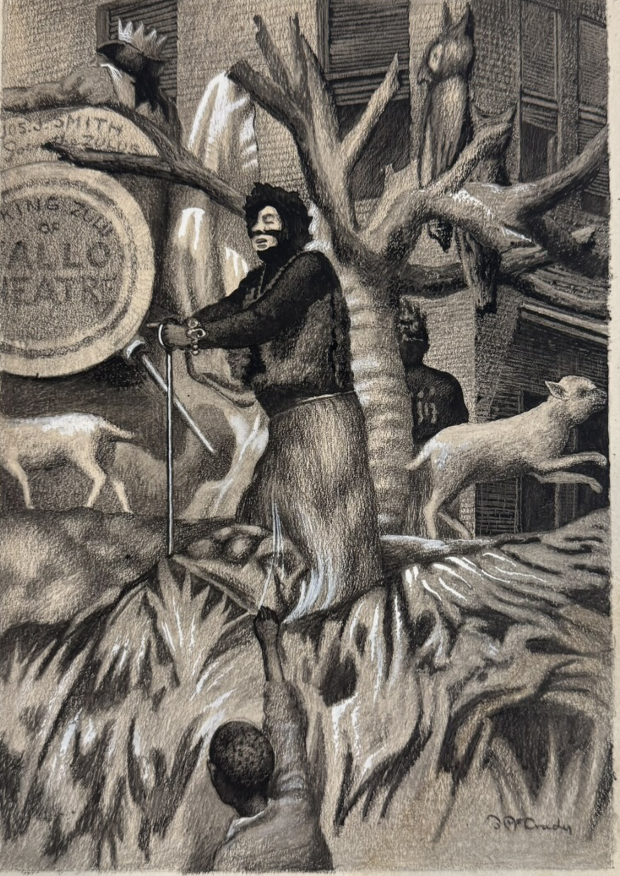
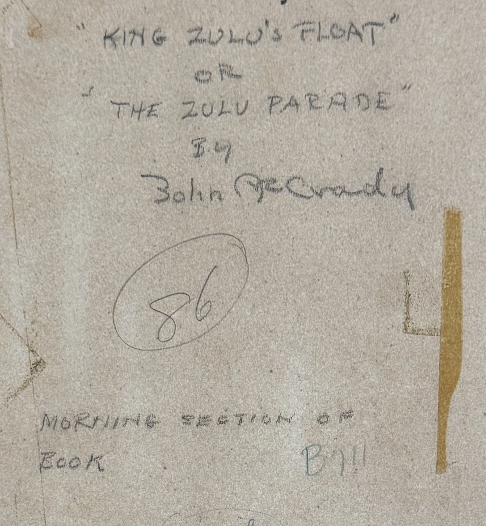
King Zulu’s Float or The Zulu Parade, 1947
charcoal and gouache on board, signed lower right, titled and signed en verso,
sight 9 5/8 x 6 5/8 in., sheet 13 x 9 ½ in.,
framed together with a copy of Mardi Gras Day by Ralph Wickiser, Caroline Durieux, and John McCrady (New York: Henry Holt and Co., 1948).
Illustrated: Ralph Wickiser, Caroline Durieux, and John McCrady, Mardi Gras Day, New York: Henry Holt and Co., 1948, p. 15.
Provenance: Private Collection, Mississippi.
In 1947, the artists John McCrady, Caroline Durieux and Ralph Wickiser created illustrations for a book on Mardi Gras Day with the book divided into 5 periods: Morning, Midday, Afternoon, Evening and Night. The volume includes a wonderful history of Carnival including the origins of masking and the pageantry of the Carnival organizations. This illustration, titled both "King Zulu's Float" or "The Zulu Parade," in the artist's handwriting, is a rare work from this volume.
"The Zulu Parade" Behind his Dukes, the Zulu King rides his float on a blue cloud. The papier-mâché lamb, in front, is the king's innocence; at the back of the float, like an afterthought, perches the owl of wisdom" (Wickiser, et al. p. 14).
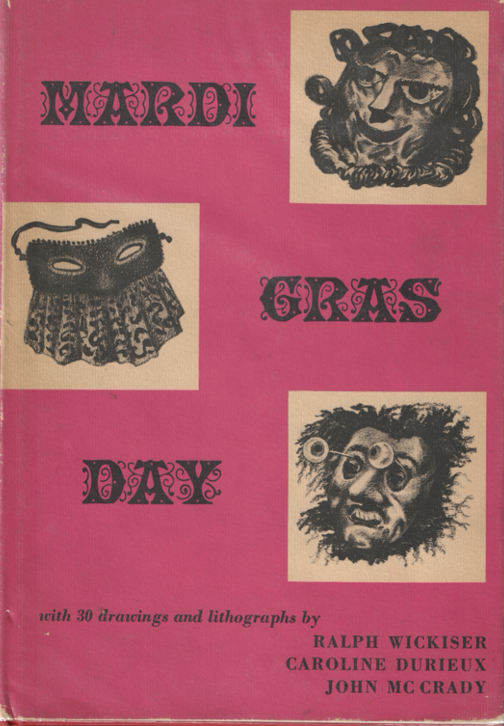
Framed together with a copy of Mardi Gras Day by Ralph Wickiser, Caroline Durieux, and John McCrady (New York: Henry Holt and Co., 1948)
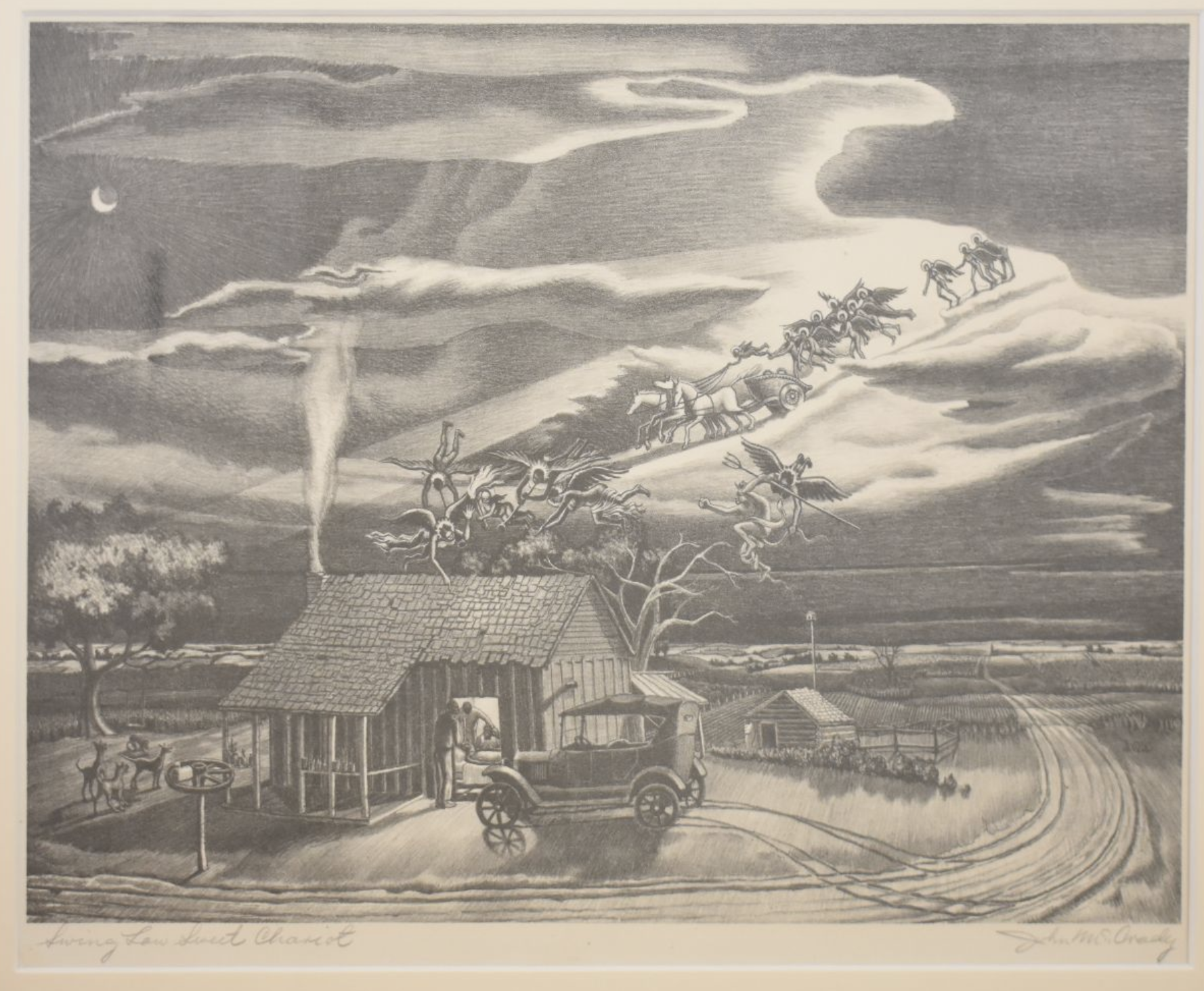
Swing Low, Sweet Chariot, 1941
lithograph, edition of 250, pub. by Associated American Artists, New York,
pencil-signed and titled, sight 11 ½ x 15 in.
Archivally matted and framed, 17 ¾ x 21 ½ in.
This lithograph is based upon the large scale multi-stage oil on canvas from 1937 in the permanent collection of the St. Louis Art Museum. This print is in excellent condition and ready to be appreciated.
Quisque iaculis facilisis lacinia. Mauris euismod pellentesque tellus sit amet mollis.